Can the client run and recover the system without the original builder standing beside it?
FDE Project Files · Episode 07
Transfer Ownership and Improve the System
Package architecture and test evidence, transfer access and recovery knowledge, teach the operating workflow, preserve extensibility, and make the next improvement decision explicit.
Coming weekly after Episode 1. Target runtime: 40 to 50 minutes.
Questions this episode answers
Make ownership survive the original builder.
These are the questions the episode keeps returning to across product, engineering, evaluation, and ownership.
Can the organization extend rules without breaking the core contract or creating uncontrolled forks?
Are post-launch decisions based on usage, quality, latency, cost, and changed operating behavior?
What you’ll see
What Episode 7 shows.
The walkthrough stays anchored to real artifacts and the decision each one supports.
The procedures needed to run, troubleshoot, recover, and escalate.
System boundaries plus the decisions and reasons that produced them.
Benchmark, regression, acceptance, and known limitations packaged for the next owner.
Who holds access, who responds, and how recovery works after handoff.
How client-specific rules can be added without destroying the core architecture.
Usage, quality, latency, cost, health, and a ranked improvement backlog tied to consequence.
Concrete 77 Rules evidence
The strongest handoff proof is that the organization can change the system without the original builder.
The governing Project File source records that a large non-U.S. bank adopted 77 Rules, added custom rules, and changed reporting practice based on findings. That supports extensibility and practical adoption without implying a specific consulting package or fee.
Review the 77 Rules case boundary and evidence →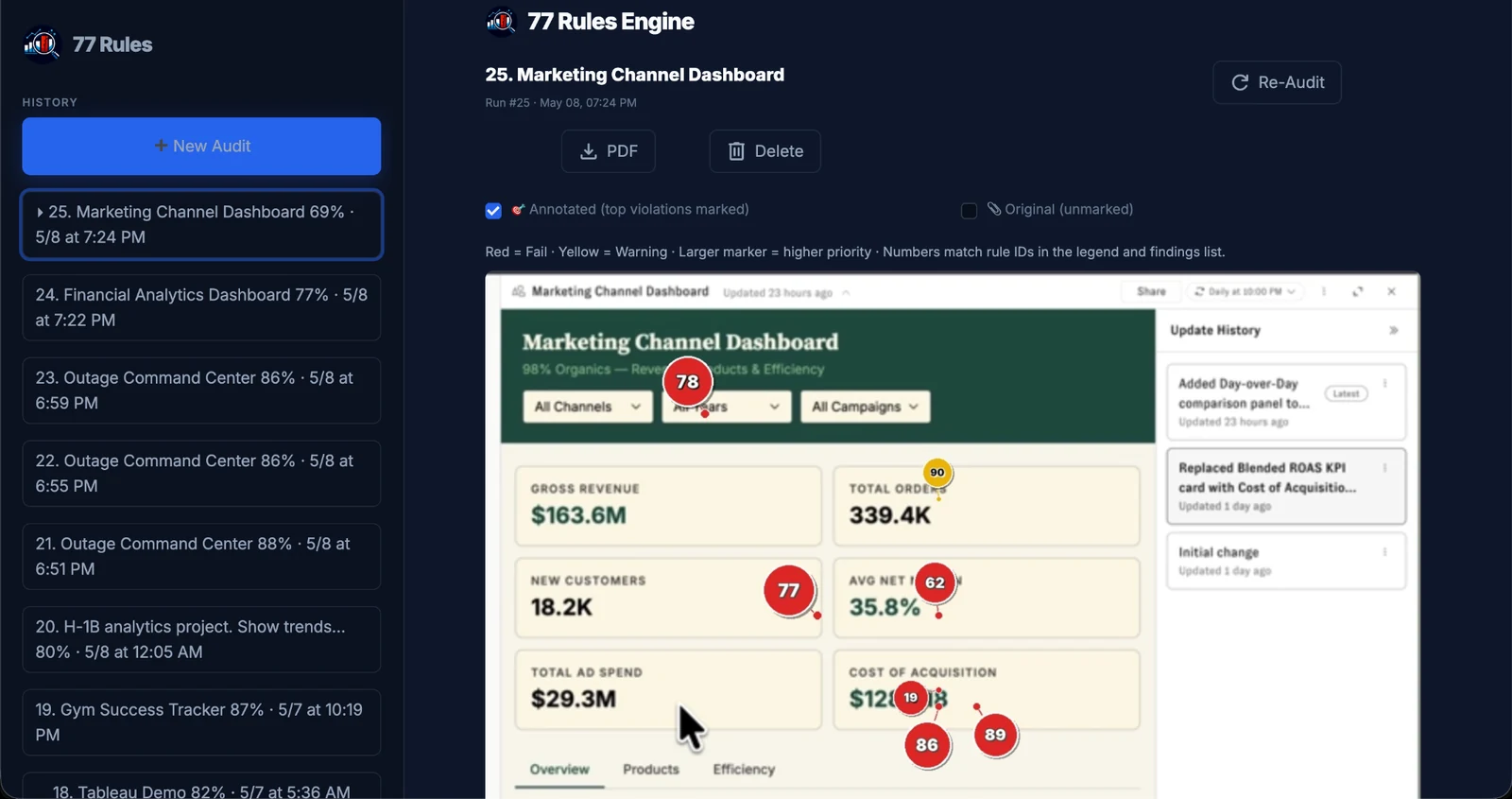
Start here
Use the same production map with your own system.
The free Starter Pack gives you the shared production map, role structure, definition-of-done framework, and core checklists used across the series.