YakData
Project File 001 · 77 Rules

What this case actually proves.

77 Rules is a live self-serve dashboard-review product and the flagship production case behind FDE Project Files. This page separates product evidence, client adoption evidence, engineering method, and the claims that are not supported.

01 · Relationship

Product case first. Client evidence second.

77 Rules is commercial self-serve software from Fast Data Secrets, LLC. YakData uses it as Project File 001 because the production decisions are unusually visible. The later bank adoption is useful evidence of extensibility and behavior change, but it is not silently recast as a bespoke YakData engagement.

Live product

77 Rules

Users upload a dashboard, inspect scored findings and evidence, fix the dashboard, and rerun the review. The public product currently offers 77 rules plus 15 bonus integrity checks.

Teaching case

Project File 001

FDE Project Files uses the same system to show requirements, architecture, model boundaries, explicit rules, scoring, evaluation, failure handling, deployment, and ownership decisions.

Client evidence

Bank adoption

The governing Project File source states that a large non-U.S. bank adopted the system, added custom rules, and changed reporting practice based on findings. That is the claim being made.

02 · Concrete public evidence

Strong design still hid integrity problems.

The public 77 Rules product example is useful because the scores and findings are inspectable rather than described in general terms.

66% · DIntegrity
87% · BDesign
73% · CCombined
8 fail7 warning · 35 pass · 42 N/A
Rule 77 · Integrity fail

Add comparative context.

Prominent KPI cards showed absolute values without immediate baselines, targets, or trend indicators.

Rule 78 · Integrity fail

State the actual time range.

“All Years” did not tell the decision-maker what reporting period the KPIs and chart actually covered.

Rule 86 · Integrity fail

Standardize monetary units.

One acquisition-cost KPI used a raw dollar figure while other monetary KPIs used millions, creating inconsistent scale.

Source: the current public 77 Rules product example. Open the public product site →

03 · What the system demonstrates

The model is one component inside explicit controls.

The production value of this case is not that AI can look at a dashboard. It is that the application turns uncertain perception into inspectable findings inside a controlled workflow.
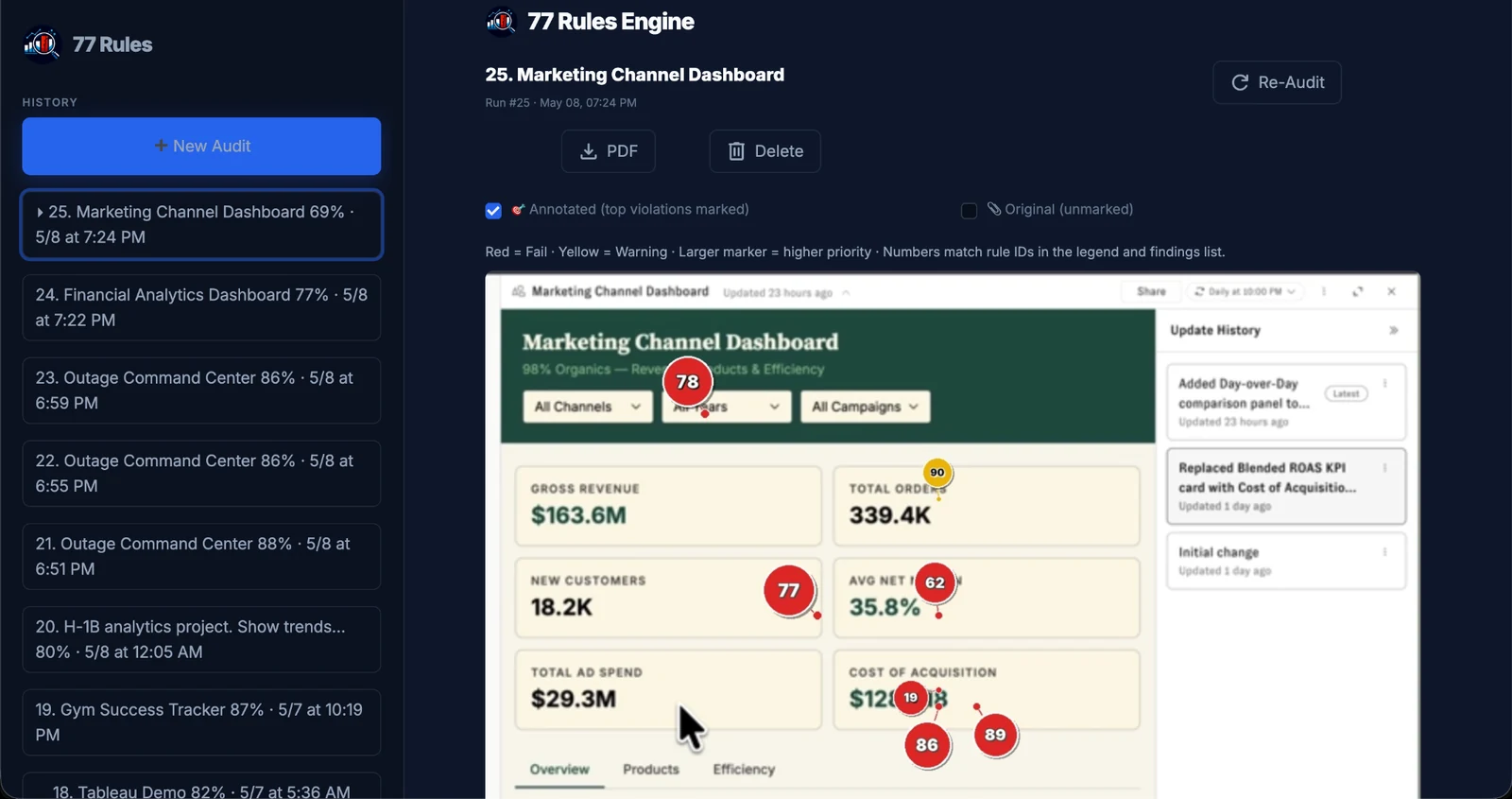
77 Rules audit workspace showing annotated dashboard findings and scores
Sanitized 77 Rules production workspace used throughout Project File 001.
  • Structured evidenceModel interpretation is converted into application data rather than allowing free-form prose to become silent system state.
  • Explicit rulesDomain judgment is represented as inspectable rules with severity, evidence, and expected behavior.
  • Deterministic scoringImportant scoring logic remains explicit rather than asking the language model to invent the final score.
  • User controlThe product lets users inspect evidence, reject findings that do not fit the context, apply fixes, and rerun. The subscription does not imply a human manually reviews each audit.
  • Failure disciplineThe teaching case explicitly covers missing context, malformed model output, false positives, false negatives, timeouts, recovery, and auditability.

04 · Client evidence

Adoption is useful evidence, but it needs the right label.

The governing Project File source records that a large non-U.S. bank adopted 77 Rules, extended it with custom rules, and used findings to change key reporting practice.

What that supports

The system was useful enough for an organization to adopt, adapt, and incorporate into reporting behavior. It supports the claims of extensibility and practical adoption.

What it does not automatically support

It does not by itself establish the scope, fee, staffing model, or timeline of a YakData consulting engagement. Those facts should only be published when independently documented.

05 · Claim boundaries

What I will and will not infer from this case.

The point of Project File 001 is to make engineering judgment visible, not to make the commercial story sound larger than the evidence.

Supported here

  • A live self-serve product exists.
  • The public example shows concrete scores, findings, evidence, and a fix-and-rerun workflow.
  • The production method uses explicit rules, structured evidence, deterministic scoring, user control, and failure testing.
  • A large non-U.S. bank adopted the system, added rules, and changed reporting practice according to the governing Project File source.

Not claimed here

  • Guaranteed ROI, accuracy, adoption, or business outcome.
  • That a human manually reviews every self-serve audit.
  • That the bank adoption was itself a particular YakData consulting package, fee, or four-week engagement.
  • Actual model-provider, latency, or per-run cost numbers until those figures are approved for publication.